by Publisher | Mar 21, 2013 | Updates
MINNEAPOLIS – With more than one million athletes now experiencing a concussion each year in the United States, the American Academy of Neurology (AAN) has released an evidence-based guideline for evaluating and managing athletes with concussion. This new guideline replaces the 1997 AAN guideline on the same topic. The new guideline is published in the March 18, 2013, online issue ofNeurology®, the medical journal of the American Academy of Neurology, was developed through an objective evidence-based review of the literature by a multidisciplinary committee of experts and has been endorsed by a broad range of athletic, medical and patient groups.
“Among the most important recommendations the Academy is making is that any athlete suspected of experiencing a concussion immediately be removed from play,” said co-lead guideline author Christopher C. Giza, MD, with the David Geffen School of Medicine and Mattel Children’s Hospital at UCLA and a member of the AAN. “We’ve moved away from the concussion grading systems we first established in 1997 and are now recommending concussion and return to play be assessed in each athlete individually. There is no set timeline for safe return to play.”
The updated guideline recommends athletes with suspected concussion be immediately taken out of the game and not returned until assessed by a licensed health care professional trained in concussion, return to play slowly and only after all acute symptoms are gone. Athletes of high school age and younger with a concussion should be managed more conservatively in regard to return to play, as evidence shows that they take longer to recover than college athletes.
The guideline was developed reviewing all available evidence published through June 2012. These practice recommendations are based on an evaluation of the best available research. In recognition that scientific study and clinical care for sports concussions involves multiple specialties, a broad range of expertise was incorporated in the author panel. To develop this document, the authors spent thousands of work hours locating and analyzing scientific studies. The authors excluded studies that did not provide enough evidence to make recommendations, such as reports on individual patients or expert opinion. At least two authors independently analyzed and graded each study.
According to the guideline:
- Among the sports in the studies evaluated, risk of concussion is greatest in football and rugby, followed by hockey and soccer. The risk of concussion for young women and girls is greatest in soccer and basketball.
- An athlete who has a history of one or more concussions is at greater risk for being diagnosed with another concussion.
- The first 10 days after a concussion appears to be the period of greatest risk for being diagnosed with another concussion.
- There is no clear evidence that one type of football helmet can better protect against concussion over another kind of helmet. Helmets should fit properly and be well maintained.
- Licensed health professionals trained in treating concussion should look for ongoing symptoms (especially headache and fogginess), history of concussions and younger age in the athlete. Each of these factors has been linked to a longer recovery after a concussion.
- Risk factors linked to chronic neurobehavioral impairment in professional athletes include prior concussion, longer exposure to the sport and having the ApoE4 gene.
- Concussion is a clinical diagnosis. Symptom checklists, the Standardized Assessment of Concussion (SAC), neuropsychological testing (paper-and-pencil and computerized) and the Balance Error Scoring System may be helpful tools in diagnosing and managing concussions but should not be used alone for making a diagnosis.
Signs and symptoms of a concussion include:
- Headache and sensitivity to light and sound
- Changes to reaction time, balance and coordination
- Changes in memory, judgment, speech and sleep
- Loss of consciousness or a “blackout” (happens in less than 10 percent of cases)
“If in doubt, sit it out,” said Jeffrey S. Kutcher, MD, with the University of Michigan Medical School in Ann Arbor and a member of the AAN. “Being seen by a trained professional is extremely important after a concussion. If headaches or other symptoms return with the start of exercise, stop the activity and consult a doctor. You only get one brain; treat it well.”
The guideline states that while an athlete should immediately be removed from play following a concussion, there is currently insufficient evidence to support absolute rest after concussion. Activities that do not worsen symptoms and do not pose a risk of repeat concussion may be part of concussion management.
The guideline is endorsed by the National Football League Players Association, the American Football Coaches Association, the Child Neurology Society, the National Association of Emergency Medical Service Physicians, the National Association of School Psychologists, the National Athletic Trainers Association and the Neurocritical Care Society.
To learn more about concussion, visit http://www.aan.com/concussion or download the Academy’s new app, Concussion Quick Check, to quickly help coaches and athletic trainers recognize the signs of concussion.
The American Academy of Neurology, an association of more than 25,000 neurologists and neuroscience professionals, is dedicated to promoting the highest quality patient-centered neurologic care. A neurologist is a doctor with specialized training in diagnosing, treating and managing disorders of the brain and nervous system such as Alzheimer’s disease, stroke, migraine, multiple sclerosis, concussion, Parkinson’s disease and epilepsy.
For more information about the American Academy of Neurology, visit http://www.aan.com or find us onFacebook, Twitter, Google+ and YouTube.
Editor’s Note on Press Conference:
Drs. Giza and Kutcher will be available for media questions during a press conference at 2:00 p.m., ET/11:00 a.m., PT, on Monday, March 18, 2013, in Room 14B of the San Diego Convention Center in San Diego. To join the press conference remotely, please call (866) 740-1260/Passcode: 6952738.Space is limited.
Drs. Giza and Kutcher are also available for advance media interviews ahead of the press conference. Please contact Rachel Seroka, [email protected], to schedule an advance interview.
by Publisher | Mar 21, 2013 | Updates
Mar 11, 6:39 PM EDT
BY HOWARD FENDRICH
AP PRO FOOTBALL WRITER
NEW YORK (AP) — NFL Commissioner Roger Goodell imagines a day in the not-too-distant future when players could be checked to determine whether their genetic makeup leaves them more likely to develop brain disease.
They then might be told to switch to a less dangerous position – or give up football entirely.
“In talking to the medical experts over several years, I think there’s a predisposition to most injuries, particularly to the brain, or to brain disease,” Goodell said in an interview with The Associated Press on Monday. “So we do want to know what those biomarkers are.”
Goodell also envisions players being required – with the union’s OK, of course – to wear helmets containing sensors to detect hits that cause concussions. Those helmets might be lighter and “less of a weapon” than today’s, he said.
Those are the kinds of advances the NFL and General Electric are hoping to produce in a partnership that could funnel up to $60 million over four years to research on head injuries and possible improvements to helmets.
“Imaging of the brain, studying the brain, is still pretty far behind the study of cancer, heart disease, things like that,” GE Chairman and CEO Jeff Immelt said. “I look at this as a catalyst in terms of where the technology will go. … I would say you’re going to start seeing really strong activities almost immediately.”
Goodell, who spoke to the AP after a news conference at a GE office building, agreed about the importance of quick progress.
“We weren’t looking at a long timetable,” he said. “We wanted to see results quickly.”
Not long after Goodell was forced to defend the league’s concussion policies at a congressional hearing in October 2009, the NFL began making changes. Among them: new return-to-play guidelines; changing the co-chairmen of the NFL’s committee on concussions; and, expected for next season, putting independent neurological experts on sidelines during games.
Thousands of former players are suing the league and its teams, saying that for years the NFL did not do enough to protect players from concussions. Next month, a federal judge is scheduled to hear oral arguments on the league’s motion to dismiss.
Such scrutiny “has no impact” on projects like the one with GE, Goodell said.
“This is about looking forward,” he said. “This is about the future. This is about changing the way all of our lives are led, whether it’s riding a bicycle or playing football or being a member of the military.”
In September, the NFL announced a donation of $30 million for medical research to the Foundation for the National Institutes of Health, the NIH’s fundraising arm.
One influential NFL owner, Robert Kraft of the New England Patriots, is pleased to see these kinds of projects now.
“I wish it had happened sooner. The evolution, the issue has been coming to the forefront and … a lot of times we didn’t talk about it, or talk about it enough. But we need to talk about it and do something about it,” Kraft said.
“Everyone has been spending money in bits and pieces, but now it will be concentrated and this will become a tremendous resource,” he added. “I don’t think anyone has the answers, how to treat it, whether to continue to play – there haven’t been answers, and we need to find the answers.”
The Head Health Initiative described Monday, which also includes sports apparel and equipment maker Under Armour, involves a four-year, $40 million research and development program to find ways to detect and diagnose brain injuries, and a two-year “innovation challenge” that would put up to $20 million toward research to protect against those injuries.
Goodell thinks helmets can be improved.
“The better protection the helmet provides, sometimes the more likely (players) are to use their head, and that’s a dilemma that we have to change, in part through rules,” Goodell said. “But I also see that we could potentially change the helmet by making it lighter. (That) would make it less of a weapon.”
AP Pro Football Writer Barry Wilner and AP Science Writer Malcolm Ritter contributed to this report.
by Publisher | Mar 21, 2013 | Updates
Published: March 18, 2013
The American Academy of Neurology said Monday that it had revised its guidelines for handling concussions to emphasize treating athletes case by case rather than according to a predetermined scale.
The move brings the group more in line with best practices followed by the N.F.L. and other leagues and associations, and it essentially acknowledges that concussions are too idiosyncratic to be categorized neatly.
“We’ve moved away from the concussion grading systems we first established in 1997 and are now recommending concussion and return to play be assessed in each athlete individually,” said Christopher C. Giza, a doctor at the David Geffen School of Medicine and Mattel Children’s Hospital at U.C.L.A. and one of the lead authors of the new guidelines. “There is no set timeline for safe return to play.”
Concussions, Giza and other authors of the report said, are clinical diagnoses. “Symptom checklists, the Standardized Assessment of Concussion (SAC), neuropsychological testing (paper-and-pencil and computerized) and the Balance Error Scoring System may be helpful tools in diagnosing and managing concussions but should not be used alone for making a diagnosis.”
The revised recommendations were announced at the academy’s annual meeting in San Diego on Monday, and they have been published in Neurology, the medical journal of the academy, which includes more than 25,000 neurologists and neuroscience professionals.
In noting that more than a million American athletes experienced concussions each year, the authors of the study noted that the risk of concussion was greatest in football and rugby, followed by hockey and soccer, and that the risk of concussion for young women and girls was greatest in soccer and basketball.
Critically, the authors found “no clear evidence that one type of football helmet can better protect against concussion over another kind of helmet.”
Signs and symptoms of a concussion include headaches; sensitivity to light and sound; changes in reaction time, balance and coordination; changes in memory, judgment, speech and sleep; and loss of consciousness or blackouts. The guidelines recommend that athletes suspected of having a concussion should be immediately removed from play.
“If in doubt, sit it out,” said Jeffrey S. Kutcher, a doctor at the University of Michigan Medical School in Ann Arbor and a member of the academy. “You only get one brain; treat it well.”
by Publisher | Dec 29, 2012 | David's Blog, Updates
2012 was an amazing year for increasing concussion awareness nationwide. Over the past year, a vast amount of research has been published that has woken up America to the dangers of concussions. Concussions are in the news now more than ever, which has served to educate the public about the need to take proper precautions when dealing with head injuries.
In Florida, meanwhile, the effort to pass youth concussion legislation was successful after over a year of tireless work. 2013 and the years to come will be safer years for Florida youth athletes thanks to this law. In Miami-Dade County, the ImPACT testing program that Countywide Concussion Care enabled has been a tremendous success. High school athletes in public high schools have greatly benefitted from having a greater awareness of concussions and being under the care of proper medical professionals. The program has become firmly established in the Miami-Dade County public high school athletic system. It will continue to provide testing and a support system for Miami-Dade public school athletes into the future. Broward County also agreed to implement a countywide baseline testing program for its high school athletes.
As for me, I am ecstatic that I am able to write all that I have just written above. I know that I have come so far from when I was a high school freshmen, doing all that I could to get through each day with my third concussion. Never would I have thought that I would have spread concussion awareness the way that I have. However, I am not satisfied, for there is more to be done and more athletes, coaches, trainers, and parents that need concussion education. In 2013, I will continue to do what I can to teach people about the dangers of concussions and how to avoid them. I wish everyone a healthy, happy, and concussion-free new year. Please write and let me know about your experiences with concussions and any interest you may have in helping to spread the word about concussion awareness, prevention, testing or legislation.
by Publisher | Dec 10, 2012 | Updates
Published: December 10, 2012
As the N.F.L. confronts a raft of lawsuits brought by thousands of former players who accuse the league of hiding information about the dangers of concussions, a less visible battle that may have a more widespread effect in the sport is unfolding between the league and 32 of its current and former insurers.
The dispute revolves around how much money, if any, the insurers are obliged to pay for the league’s mounting legal bills and the hundreds of millions of dollars in potential damages that might stem from the cases brought by the retired players.
Regardless of how it is resolved, the dispute could hurt teams, leagues and schools at all levels if insurers raise premiums to compensate for the increased risk of lawsuits from the families of people who play hockey, lacrosse and other contact sports.
The N.F.L., which generates about $9 billion a year, may be equipped to handle these legal challenges. But colleges, high schools and club teams may be forced to consider severe measures in the face of liability issues, like raising fees to offset higher premiums; capping potential damages; and requiring players to sign away their right to sue coaches and schools. Some schools and leagues may even shut down teams because the expense and legal risk are too high.
“Insurers will be tightening up their own coverage and make sports more expensive,” said Robert Boland, who teaches sports law at New York University. “It could make the sustainability of certain sports a real issue.”
The N.F.L. contends that the insurers, some of whom wrote policies in the 1960s, have a duty to defend the league, which has paid them millions of dollars in premiums. The question for the N.F.L. is not whether the insurers are required to help the league, but rather what percent of the league’s expenses each insurer is obliged to cover.
The 32 insurance companies have varying arguments against the league. Some wrote policies for a limited number of years and contend their obligations should also be limited. Others contend they wrote policies for the N.F.L.’s marketing arm — for licensing disputes, for example — not the league itself.
A few of the companies went bankrupt or merged with rivals. Some insurers wrote primary policies that covered up to the first $1 million of claims; the rest insured obligations in excess of that amount.
Creating a formula for how to apportion liability will in some cases depend on the broader case between the league and its players now in federal court in Pennsylvania. If the N.F.L. persuades the judge to dismiss the case, the league will be left trying to recoup its legal costs from the insurers. If the judge allows the players’ case to proceed, the definitions of when, how and whether a player’s concussions led to his illness will become critical in shaping the insurers’ exposure, and could take years to sort out.
“This is baby step 1 in the process for everyone figuring how deep in the soup they are,” said Christopher Fusco, a lawyer who has worked on similar insurance cases but is not involved in the N.F.L. litigation. “Baby step 2 will be to figure out the facts.”
Fusco and other lawyers said the facts would largely come from the underlying suit between the league and the more than 3,000 retired players, including determining when the players sustained the head trauma and their injuries. This will probably be a long process because many of the retired players in the underlying suit, some of whom are now having memory loss, played decades ago, when concussions were often undiagnosed or not recorded.
Many of the insurance companies named in the suits declined to comment, citing the continuing litigation. The N.F.L. also did not comment.
The two-tiered battle between the league and its former players and insurers echoes the litigation stemming from asbestos claims because both cases center on long-tail claims, or injuries that could take years to manifest themselves.
Page 2 of 2
One of the critical points of contention in those cases was how to define an occurrence to determine an insurer’s liability. In the context of the N.F.L. case, the question will be whether a player’s injuries should be treated as a single claim or a series of claims based on the number of concussions he received or the number of seasons he played.
“This is an issue that gets to the crux of asbestos and environmental litigation,” said William M. Wilt, the president of Assured Research, an insurance advisory firm. “If an occurrence is defined as each player and each season he played, you could hit the policy limits multiple times.”
The current case, though, is far smaller than the asbestos cases because the potential plaintiffs are limited to the number of former pro football players. The effects of the legal wrangling, though, may reverberate throughout the sports world regardless of how the retired players do in court.
Fearful of future lawsuits, insurers may start raising premiums or excluding concussions and other injuries from their policies not just for the N.F.L., but also for hockey and lacrosse and other contact sports. As information about the link between head trauma and long-term injuries has grown, coaches, athletic directors and others will have a harder time claiming they did not know of the connection if they are named in lawsuits.
“A common misconception is that no one’s going to sue their youth league or nonprofit, but that’s not the case,” said Dan Pullen, who runs an insurance brokerage in Fort Worth that specializes in policies for teams, players and leagues. “Maybe the league isn’t negligent, but there might be $50,000 in legal claims” for a lawyer to chase.
The cases against the N.F.L. are likely to be the most explosive because of the news media spotlight and because so much money is at stake. The players are also more organized than, say, collegiate players, who do not have a union. Nevertheless, there is no shortage of plaintiffs’ lawyers willing to represent former players.
“The handwriting is on the wall, there’s no question,” said John Kircher, a law professor at Marquette University who specializes in the insurance industry. “Insurers will look at the dangers and might look at increasing premiums, and the insurers and the insured will ask whether the game is worth a candle.”
Kircher and other experts say they expect the courts to force the league’s primary insurers to at a minimum pick up the N.F.L.’s legal fees, which are already in the millions of dollars.
The larger issue for the courts will be to decide whether the primary insurers will have to carry more of the burden than the insurers who wrote the excess policies, which are policies that cover claims beyond the scope of primary policies. Because insurance laws vary from state to state, the answer may depend on where the cases are tried, and here, the insurers may have the upper hand.
New York law is thought to be more favorable to insurers. In August, Alterra America Insurance, which wrote an excess liability policy for the N.F.L., sued the league in State Supreme Court in New York. Alterra said it was not liable for injuries occurring on the field. In its complaint, Alterra said it chose New York as the venue for the case because the N.F.L. has its headquarters there.
The league responded by suing 32 insurers, including Chartis Specialty Insurance Company, Fireman’s Fund Insurance Company and several subsidiaries of Travelers, in State Superior Court in Los Angeles, arguing that California was the right venue because, among other things, it has 3 N.F.L. teams and has hosted 11 Super Bowls, and N.F.L. Properties, the licensing unit of the league, was incorporated there.
California law is also considered friendlier to policyholders, insurance specialists said.
But in late November, the court said that the N.F.L. was “selective and tactical” in choosing California and ruled that New York was the better venue for the case. The judge, John Wiley, did not dismiss the case, but said he wanted to see what happened in New York first.
“The superfluous effort is not simply wasteful: it also poses the added threats of confusion and inconsistent results,” Wiley wrote in his decision. “It is better to streamline and to simplify.”
by Publisher | Nov 14, 2012 | Print Coverage, Updates
Football players undergo baseline testing and evaluation before resuming play
November 14, 2012
By Christy Cabrera Chirinos, Sun Sentinel
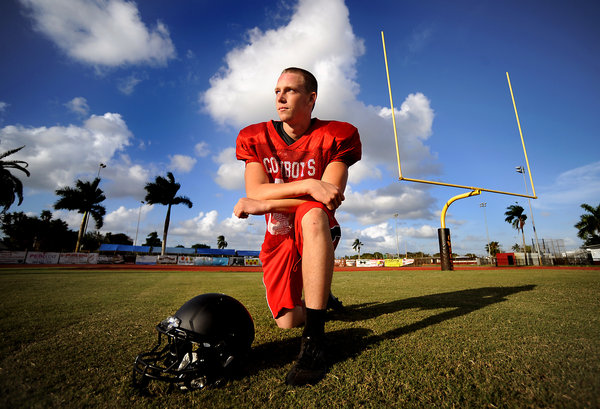
Cooper City football player Tyler Sabine took a brutal hit in a game early this season. The sophomore was throwing up just before halftime. His coaches knew it was time to pull the linebacker from the game.
Two days later, Sabine was diagnosed with a concussion.
That diagnosis kicked into place new guidelines passed by the Florida Legislature eight months ago, establishing strict procedures to allow concussed athletes, such as Sabine, back on the field.

As the
high school
and youth football seasons wrap up this month, many say the new law on concussion management is working.
Sabine was sidelined for more than two weeks before doctors cleared him to begin the gradual four-step return-to-play protocol now mandated by the Florida High School Athletic Association.
“Our trainers were amazing once they realized there was an issue,” said April Bourassa, Sabine’smother. “It was scary. It’s a brain injury, and it’s not like you have another one of those. But they’ve really made it to where now, you’re more informed and I love that. Everyone was very thorough. I felt like my son was being taken care of and informed.”
High school coaches and parents are being more hands-on about concussion awareness. Injured athletes are being evaluated by physicians, and sitting out as long as needed. Once medical clearance is given for them to return, athletic trainers are helping those athletes follow state guidelines that gradually manage a safe return to play.
“This is something that had to be dealt with,” said Archbishop McCarthy coach Byron Walker, who has seen one of his players, running back Nick Bost, sidelined with a concussion this season. “It takes it out of the hands of people who have an interest and puts it in the hands of professionals. It’s just going to be safe for the kids in the end.”
Bost, who was injured during spring practice, only recently returned to action after dealing with post-concussion syndrome months after his concussion.
“I knew it had to be done,” Bost said. “It may have been a mild concussion, but I wanted to be cautious and because I was still having symptoms, I held myself out. And my coaches were cool about it. They understood.”
Returning to action
The new law requires that if an athletic trainer or coach suspects an athlete has suffered a concussion, the athlete must be removed from play. And once an athlete has been diagnosed with a concussion, he or she cannot return to play until medically cleared by a physician.
Once that clearance is given, state policy dictates an athletic trainer supervises a four-step return-to-play protocol in which athletes see their activity level increase daily. If at any point in the process, an athlete exhibits concussion symptoms such as dizziness or sensitivity to light, they must wait at least 24 hours before attempting that level of activity again.
Youth football leagues across South Florida also are working to keep the youngest football players safe. Ross Sinel, president of the American Youth Football League, which includes teams from Broward, Palm Beach and Miami-Dade counties, said educating coaches and parents has been a major part of the league’s concussion management efforts.
And like high school athletes, no concussed AYFL athlete can return to play without a physician’s clearance.
“We had a clinic for our coaches with the doctors from the University of Miami, we have a policy where all coaches and parents have to sign off on concussion documents, and the AYFL has kept a database of all the concussed kids,” Sinel said.
In addition to the new state law which went into effect July 1, Broward County Schools have mandated baseline concussion testing for all high school athletes.
In Palm Beach County, more than 600 football players have participated in voluntary baseline testing.
All of that has helped lead to increased education and awareness of an often-misunderstood injury that if not treated properly, could have lasting effects on young brains.
“I think it’s all helping people do their jobs more effectively,” said Stephen Russo, the director of Sports Psychology at the Nova Southeastern University Sports Medicine Clinic. “The athletic trainers are overseeing the return-to-play protocol, the doctor is doing the medical approval, I’m doing what I’m trained to do and the coaches, at the end of the day, are doing what they’re trained to do. Everyone has their assigned roles in helping the athletes.”
Russo is working with the Broward County Athletic Association to carry out its baseline testing program. He estimates that this year, more than 50 athletes already have come to Nova’s Sports Medicine Clinic for post-concussion evaluation. In the entirety of the 2011-2012 school year, the clinic saw 101 cases.
At Cleveland Clinic in West Palm Beach where Dr. Evan Peck is helping Palm Beach County schools carry out its voluntary testing, there’s been an increase in patients, too.