by Publisher | Mar 2, 2011 | News Coverage
The First Miami-Dade Countywide Concussion Care Workshop presented by the KiDZ Neuroscience Center at The Miami Project to Cure Paralysis and UHealth Sports Medicine Center
March 2, 2011 – The KiDZ Neuroscience Center at The Miami Project to Cure Paralysis and the UHealth Sports Medicine Center will host the first Concussion Care Workshop March 3rd for more than 100 Miami-Dade County Public High Schools (M-DCPS) athletic trainers and athletic directors. The event is intended to educate and implement in the M-DCPS Senior High Schools concussion management programs and ImPACT Testing. The program will take the unprecedented step of implementing the performance of baseline neurocognitive testing this year for each student athlete in the contact sports of football, girls volleyball, boys and girls soccer, baseball and softball.
Presentations during the morning long conference will include experts in field and stakeholders in the fight against concussions including; Dr. Lee Kaplan, Director UHealth Sports Medicine Center, Vinny Scavo, UHealth Sports Medicine Director of Sports Medicine Services & Head Athletic Trainer, Cheryl Golden, Instructional Supervisor, Greater Miami Athletic Conference, Division of Athletic/Activities, Miami-Dade County Public Schools, David Goldstein, a student at Ransom Everglades who has suffered from concussions, Dr. Kester Nedd, Director Neurorehabilitation UM/JMH and Co-Director Concussion Program at UHealth Sports Medicine, Dr. Gillian Hotz, Director KiDZ Neuroscience Center and Concussion Program at UHealth Sports Medicine, and ImPACT Training via webinar from Doug Tauchen. Marc Buoniconti, President of The Miami Project to Cure Paralysis will offer the closing remarks.
“This Countywide Concussion Care Program will allow each High School Football Player and eventually every Junior Varsity and Varsity player in high risk sports baseline ImPACT testing. This will allow us to have an objective cognitive assessment to assist in the management of their concussion and to returning them back to the game safely,” said Dr. Hotz.
“The M-DCPS are excited to help develop and implement Concussion Management Programs in the senior high schools athletic programs. The ability to implement ImPACT testing to our athletes is a huge tool to add to the education of our patents, student athletes, coaches, faculty and administrators help in the understanding of the concussion diagnoses, treatment and safe return to play for all of our student athletes,” said Cheryl Golden.
The KiDZ Neuroscience Center (KNC) is under the auspices of The Miami Project. The KiDZ Injury Prevention & Research Program will focus specifically on injury prevention in childhood. The program will be dedicated to tracking the types, causes, and consequences of childhood injuries by using epidemiological tools to identify risk factors for injury. This program will encompass the WalkSafe™, BikeSafe™, and Car Seat programs. Dr. Hotz is the Director of the WalkSafe Program, which considered one of the best pediatric pedestrian injury prevention programs in the country. Its primary goal is to reduce the number of injuries and fatalities of children (ages 5-13). WalkSafe pioneered the injury prevention model which was adopted by the National Center for Safe Routes to School Initiative. Currently, a feasibility study is taking place for BikeSafe. Dr. Hotz also directs the Concussion Program which serves the public and private high school and college sports teams (football, soccer, wrestling, etc.) and athletes from the community. This program offers comprehensive evaluations and recommendations for returning to play safely.
ImPACT (Immediate Post-Concussion Assessment and Cognitive Testing) is the first, most-widely used, and most scientifically validated computerized concussion evaluation system.
Developed in the early 1990’s by Drs. Mark Lovell and Joseph Maroon, ImPACT is a 20-minute test that has become a standard tool used in comprehensive clinical management of concussions for athletes of all ages. ImPACT Applications, Inc. was co-founded by Mark Lovell, PhD, Joseph Maroon, MD, and Michael (Micky) Collins, PhD.
Given the inherent difficulties in concussion management, it is important to manage concussions on an individualized basis and to implement baseline testing and/or post-injury neurocognitive testing. This type of concussion assessment can help to objectively evaluate the concussed athlete’s post-injury condition and track recovery for safe return to play, thus preventing the cumulative effects of concussion. In fact, neurocognitive testing has recently been called the “cornerstone” of proper concussion management by an international panel of sports medicine experts.
by Publisher | Feb 23, 2011 | News Coverage, Print Coverage
TALLAHASSEE — David Goldstein was a freshman on his high school soccer team last year when he was called in to sub during district finals.
It was a dream situation, one he couldn’t let go even after colliding head-to-head with another player in the first half. “My hands went to my head, and I knew something wasn’t right,” he said.
Goldstein played through the second half for Miami’s Ransom Everglades and during a scrimmage the next day. He didn’t figure out he was probably suffering from a concussion until he could hardly move from the pain. Goldstein says he could have avoided the headaches, nausea and months of hourslong naps during school had he been properly educated about brain injuries and stopped playing.
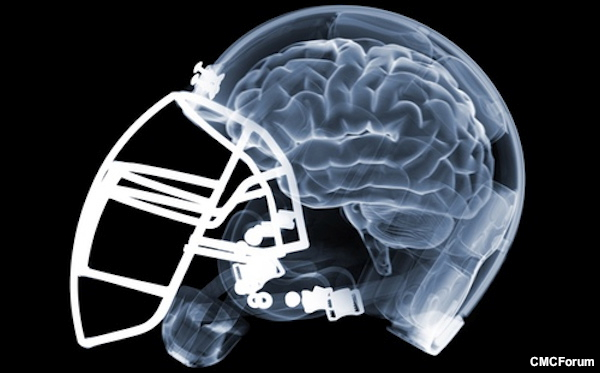
Now he’s on a mission with a batch of state lawmakers, former NFL players and medical experts. They spoke at the Capitol on Tuesday to support a bill that aims to curb concussions in youth sports through education and regulation.
“In the past, it was ‘you got your bell rung.’ You shake it off and got back in the game,” said Rep. Ronald Renuart, R-Ponte Vedra Beach, a bill sponsor.
HB 301 and SB 730 would require the Florida High School Athletic Association to remove athletes showing signs of a concussion during a game or practice until they receive clearance from a medical professional.
Students and parents would sign consent forms that explain the risk of concussions, and returning to play too soon, every year before the start of practice or games. These rules would not just apply to FHSAA-governed sports, but to organized youth athletics at government-owned facilities. The FHSAA supports the measure.
National experts estimate 140,000 high school athletes suffer concussions every year. About 40 percent return to play before they have recovered. Repeat concussions can affect mood, social development, memory and worse, Renuart said.
A national poll last fall found that only 8 percent of parents with children ages 12-17 who play school sports have read or heard about the risks of repeat concussions.
Nine states have passed similar bills. NFL Commissioner Roger Goodell wants each state to have a law by 2015, said Kenneth Edmonds, the league’s government relations and public policy director.
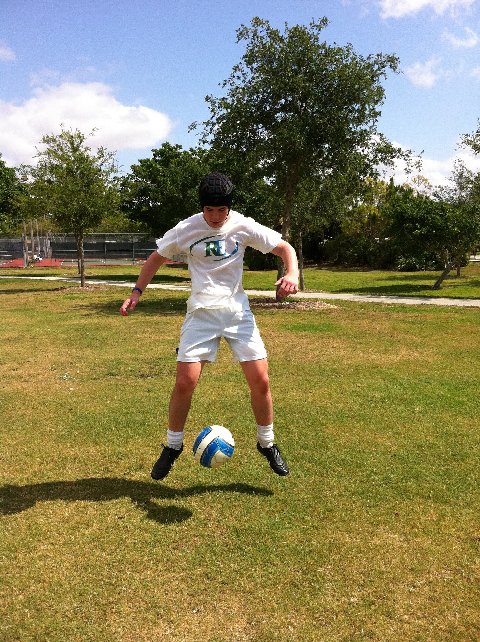
Goldstein still plays soccer, though only while wearing a rugby helmet. He came to Tallahassee with his parents, Cheryl and Adam, who is president and CEO of Royal Caribbean International.
“Now I know, and I’m a different player now,” he said. “I’m trying to spread that message to as many people as possible.”

by Publisher | Feb 22, 2011 | News Coverage, Print Coverage
Tallahassee, Florida — Every year, an estimated 140,000 high school athletes suffer concussions across the United States.
Athletes say, too often, they just dismiss the injury as “getting your bell rung” and they return to play before they’re ready.
The Brain Injury Association of Florida says that can be especially dangerous for the still-developing brains of young people.
Now a proposed bill aims to prevent injured high school athletes from returning to play too soon.
The legislation would require injured students to receive written clearance from a doctor before returning to play, as well as educatestudents, coaches and parents about the dangers and symptoms of concussions.
Sixteen-year-old David Goldstein spoke in favor of the bill at the state Capitol on Tuesday. He painfully understands the consequences of ignoring the symptoms of a concussion.
Goldstein sustained a serious concussion last year during a soccergame and even though it caused headaches, nausea and fatigue, he continued to play.
Now he knows that was a mistake. Goldstein thinks the bill will help prevent other student athletes from going through his experience.
“I learned the hard way and it didn’t have to be that way. That’s why I support the sports concussion legislation because it is about education and trying to prevent serious or permanent brain damage by keeping an injured player from going back into the game too soon.”
Rep. Ronald “Doc” Renuart, a doctor for more than 40 years, is sponsoring the legislation.
He says it would also create uniform guidelines for schools on removing athletes from a game when they suffer head injuries.
“This is a time for us to work together to protect our student athletes when they’re at the most vulnerable stages of brain development. I just met David for the first time today and thought he was rather articulate. But unfortunately his very compelling story is not unique and it points out the need that we have to have standards across the state to protect our students.”
Former NFL Player Lawrence Dawsey says he has a 12-year-old son that plays sports. Dawsey says a bill like this is needed.
“To have a bill like this in place would definitely make me as a parent feel more comfortable knowing that we’re doing all that we can do as a state to help our kids be successful on the field as well as off the field .”
The Brain Injury Association is also unveiling a new database of services available for people with traumatic brain injuries and their families. The website is located at: www.byyourside.org.
Dave Heller
by Publisher | Feb 22, 2011 | News Coverage
TALLAHASSEE — David Goldstein was a freshman on his high school soccer team last year when he was called in to sub during district finals.
It was a dream situation, one he couldn’t let go even after colliding head-to-head with another player in the first half. “My hands went to my head, and I knew something wasn’t right,” he said.
Goldstein played through the second half for Miami’s Ransom Everglades and during a scrimmage the next day. He didn’t figure out he was probably suffering from a concussion until he could hardly move from the pain.
Goldstein says he could have avoided the headaches, nausea and months of hours-long naps during school had he been properly educated about brain injuries and stopped playing.
Now he’s on a mission with a batch of state lawmakers, former NFL players and medical experts. They spoke at the Capitol on Tuesday to support a bill that aims to curb concussions in youth sports through education and — unpopular as it may sound this year — regulation.
“In the past, it was you got your bell rung. You shake it off and got back in the game,” said Rep. Ronald Renuart, R-Ponte Vedra Beach, a bill sponsor.
“Those days are over,” said Sen. Antiere Flores, R-Miami, a co-sponsor. “Quite frankly, we know better.”
HB 301 and SB 730 would require the Florida High School Athletic Association to remove athletes showing signs of a concussion during a game or practice until they receive clearance from a medical professional. Further, students and parents would sign consent forms that explain the risk of concussions, and returning to play too soon, every year before the start of practice or games. These rules would not just apply to FHSAA-governed sports, but to organized youth athletics at government-owned facilities. FHSAA supports the measure.
National experts estimate 140,000 high school athletes suffer concussions every year. About 40 percent return to play before they have recovered, habits that often worsen the effects.
Repeat concussions can affect mood, social development, memory and worse, Renuart said. A national poll last fall found that parents are considerably in the dark. Only 8 percent with children aged 12-17 who play school sports have read or heard about the risks of repeat concussions. Nine states have passed similar bills.
NFL Commissioner Roger Goodell wants each state to have a law by 2015, said Kenneth Edmonds, the league’s government relations and public policy director.
Nat Moore, a former Miami Dolphins receiver and now a team vice president, said the bill is “near and dear” to his heart: “On behalf of the Miami Dolphins, I pledge that we will do everything we can to help facilitate this and make this happen.”
Goldstein still plays soccer, though only while wearing a rugby helmet. He came to Tallahassee with his parents, Cheryl and Adam, who is president and CEO of Royal Caribbean International.
“Now I know, and I’m a different player now,” he said. “I’m trying to spread that message to as many people as possible.”
by Publisher | Oct 21, 2010 | Featured, TV Coverage
[flowplayer src=’http://pserver.mii.instacontent.net/wsvn/WSVN_20101021180956473C.mp4′ width=600 height=338 splash=’http://184.168.81.131/~concussi/wp-content/uploads/2010/10/WSVN-ConcussionConcern.jpg’]
Just this week the NFL is starting to suspend players for vicious head hits. It’s a problem that starts in high school. The number of student athletes suffering head injuries is on the rise. 7s Richard Lemus has more about this Concussion Concern.
WSVN — It’s these violent helmet to helmet hits which prompted the NFL to punish players with hefty fines. From pro football to high school soccer, there are 100s of Youtube videos showing bone crunching hits on the field.
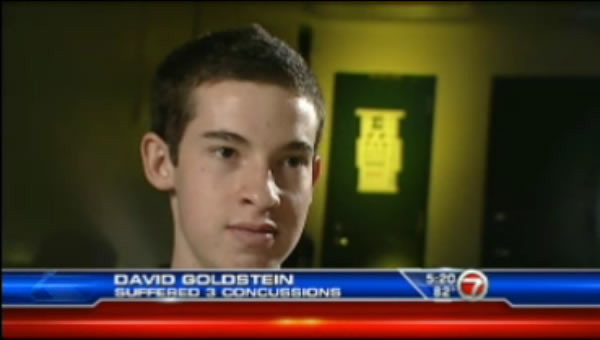
15-year-old David Goldstein knows firsthand how that feels.
David Goldstein: “A ball was rocketed at my head. I was dizzy and in a lot of pain.”
He got his first concussion playing soccer at age 12. His second came after a head to head collision with another player.
David Goldstein: “I was in a lot of pain, seeing stars.”
Both times David went right back in the game. Then in January during the district final against rival Gulliver Prep…
David Goldstein: “I’m thrown into the game and it’s the most important game I’ve ever played in my life.”
Another head to head collision video shows David stumbling across the field holding his head again. He continued playing, but after the game he collapsed.
David Goldstein: “Just thinking about how much it hurt was unbelievable. I couldn’t move I was in so much pain.”
Dr. Gillian Hotz: “We’re really worried now about the young and developing brains, so multiple hits of this type on the brain will really play havoc later on in life.”
Dr. Gillian Hotz of the concussion program at UM says, scientists are starting to realize even one hit can cause brain damage later in life.
Coach Mo Blake deals with injured student athletes at Ransom Everglades. He knows the tremendous pressure they’re under to perform.
Mo Blake: “If they are trying to mask the injury or say ‘I’m OK just give me a couple minutes,’ that’s where we as the coaches, adults and trainers have to really look out what’s best for the kid.”
That’s why school adminstrators at Ransom have implemented the Impact Test for all student athletes.
Claude Grubair: “You take it to get a baseline of where you are under your normal condition, and then you take the post-injury test.”
The Impact Test uses words and shapes to test a student’s memory, mental speed and reflexes. Following a head injury, the student repeats the test if there are any changes in thought pattern any red flags at, all the child is sent for medical treatment right away.
Dr. Gillian Hotz: “We’re able to take a look at the baseline testing and the repeated testing and take a look at the differences and make the proper recommendations.”
Coach Blake says the impact test leaves nothing to chance if a student tries to cover up an injury. The test tells the truth something coaches are glad to have.
Mo Blake: “To not use this tool I think would be detrimental to the student athletes.”
David wishes he had the impact test after his first concussion.
David Goldstein: “If I had that support and that knowledge before my situation would have been a lot better.”
That’s why he is now behind a massive effort to get the impact test into more schools.
David Goldstein: “The initiative now is to raise enough money to provide impact testing for all the public schools in Miami-Dade County with athletic programs.”
Months later David has been cleared to go back to the game he loves.
David Goldstein: “Having all of this behind me gives me the confidence to go back on the soccer field.”
Knowing the impact test and his doctor’s support lowers his concussion concern.
Richard Lemus: “Congress is considering a bill that would establish standards for student athletes who get concussions.”
FOR MORE INFORMATION:
Dr. Gillian Hotz
UHealth Sports Medicine
Tel: (305) 243-3000
http://uhealthsportsmedicine.com/conditions-and-treatment/concussion
by Publisher | Oct 11, 2010 | News Coverage, Print Coverage
University of Miami program targets concussions in young athletes
If your high school son or daughter gets knocked in the head on the playing field anywhere in Miami-Dade, chances are Dr. Gillian Hotz and her colleague Dr. Kester Nedd will soon be on your speed dial.
The two have teamed up to spread the word on concussions and push for high school athletes to be tested before an injury occurs, thus establishing a baseline that will help determine treatment and assess their recovery.
At the start of the 2009 school year, Hotz said she was seeing three to four young athletes a week at the clinic at the University of Miami Hospital. This year, she’s seeing about 14 or 15 kids a week who have head injuries from playing football, soccer and other sports.
It’s not that the sports have become more dangerous. On the contrary, sports equipment is improving, said Vincent Scavo, who spent 17 years in the Miami-Dade County Schools system as an athletic trainer.
“What’s happening now is we’re educating people better,” Scavo said. “The way we handled equipment years ago was we gave the athlete a helmet and said, `Go play.’ Now, we’re conscious of how we fit the helmet. . . . That’s so important today. The hitting is unbelievable — even at the high school level.”
Scavo’s son Alec is a senior and defensive lineman on the football team at Christopher Columbus High School.
Hotz and Scavo, now the director of Sports Medicine Services at the University of Miami Miller School of Medicine, attribute the increase in clinic visits to better awareness and education. Teachers and coaches have been trained to identify concussion symptoms, which include headaches, dizziness and vision problems.
“A few years ago people had a headache or some type of concussion symptom and they would ignore it and say they are fine,” Scavo said. “We realize now that’s not the way to go. Concussions are dangerous. Athletes don’t want to come out of the game. That’s why it’s so important that athletic trainers deal with athletes and teachers to educate the athlete and say, `It’s OK, you have a problem, we’ll get you better.’ ”
But more needs to be done.
Along with The Miami Project to Cure Paralysis, Ransom Everglades in Coconut Grove has teamed with the UM to increase awareness of concussions in sports and raise money to help schools in Miami-Dade adopt ImPACT testing. The goal is to get a baseline reading for all public high school football players next year.
So far, Ransom, Miami Palmetto Senior High, G. Holmes Braddock Senior High and Terra Environmental Research Institute offer ImPACT baseline testing for its student athletes. Colleges and the NFL also use the program.
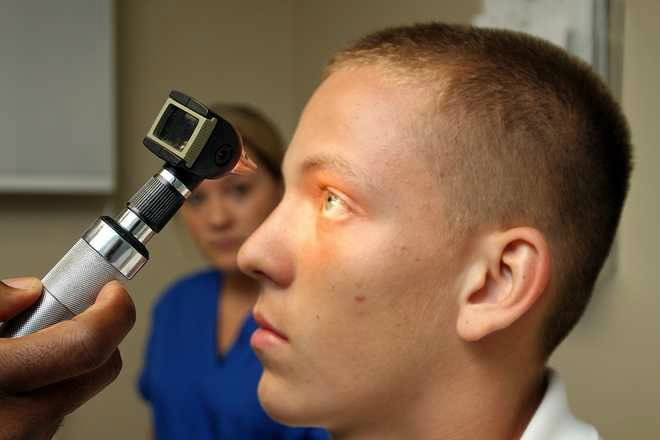
“ImPACT is an amazing tool, a positive step forward,” said Cheryl Golden, instructional supervisor for Miami-Dade County Public Schools. “Head injuries are an enigma to parents, coaches and kids. It’s not like a broken bone that you can X-ray. With a concussion you don’t have physical proof and that’s what makes ImPACT so valuable.”
Students are tested by answering questions in a computer program; the questions revolve around memory, reflex and timed situations. The ImPACT materials can cost about $600 per school.
“It’s tough for these schools, they don’t have resources,” Hotz said. “They are doing the best they can. Some of these programs in rural parks don’t have a trainer. It’s a dad or a neighbor that’s a coach. If a kid’s really not right, he’s got to be seen, he’s got to be followed, and the school has to play a role in that. They are the gatekeeper.”
David Goldstein, 15, has become one such gatekeeper.
In September, the Ransom 10th-grader addressed representatives from The Miami Project, joining with speaker Marc Buonoconti, a Citadel University football player who was paralyzed during a game in 1985.
Goldstein introduced his school to the work done at the UM clinic after he suffered his third head injury in four years while playing soccer in January.
“I struggled with my situation for a long time. I found doctors Hotz and Nedd here at the Sports Medical Center and they helped me out,” Goldstein said.
The first step in his rehabilitation was ImPACT’s 30-minute computerized test to gauge his motor skills and to determine how serious his head injury was.
“My mental skills were nowhere near what they should have been,” Goldstein said. “They helped me out by finally getting me on medicine. I had a timeline of what to do when and how to come back from the injury. They introduced me to concussion testing.”
Quite a difference from months earlier. After Goldstein’s accident on the field, he practiced the next day.
“I got into the car after and collapsed under the pain,” he said. “I couldn’t move. I went to a couple neurologists who said I should never play soccer again,” he said.
“I’ve played since I was 4. To think I couldn’t play again devastated me. I thought I would wait it out but after three to four months I was having so much pain I had to sleep through a couple periods of school a day,” Goldstein said.
His mission now: Make baseline testing the norm at all schools by the 2011-2012 year.
For a 10-year period ending in 2007, the American Academy of Pediatrics tracked emergency room visits for concussion in children ages 8 to 13 and for teenagers who are all involved in organized sports. Emergency room visits among the younger group doubled and increased by more than 200 percent among the teens. More than 500,000 visits were reported for the combined groups.
Part of the reason for the increase, Nedd says, is the evolution of awareness and treatment. Concussions, and the push for baseline testing of student athletes, has received national attention.
Nedd acknowledged that injuries can’t be completely avoided in contact sports like boxing and football.
“The real issue is the long-term impact on people’s lives. Can they return to work? At school, can they perform at a level that will be deemed acceptable? The interpersonal relationships. When you look at pro athletes and the problems they have, a lot of time they have unrecognizable head injuries they received in junior high and high school. Even mild head injuries affect personality.”
The formative pre-teen and teen years can be most critical, Nedd said.
“Some of the ills we have in society may have a basis in an injury to the brain at an early age.”
Nicholas Johnson, a 10th-grade defensive end at Coral Gables High, sits on an examination table inside the University of Miami Hospital on a recent Tuesday afternoon.
The preceding Wednesday, he suffered a head injury during a football game.
“One of the players on the other team hit me helmet to helmet at least six times,” said Johnson, 15.
He wasn’t overly concerned during the excitement of the game, he said. “I got up, didn’t think much of it and went back to the huddle. It didn’t bother me until I got home that night.”
Thursday, his vision blurred, he couldn’t concentrate on a test in sixth period and his head started to hurt.
That first night, his mother recommended that Nicholas check in with Coral Gables’ athletic trainer, who prescribed immediate rest and set up an appointment for Nicholas at the UM clinic to undergo testing.
“I was glad to see they are very conscientious and were paying close attention to what’s happening with him,” said his mother, Doris Johnson.
Lacking a baseline score, the doctors ran Nicholas through a series of tests, both paper and pencil question-and-answer, and neurological tests of motor skills.
The verdict? An inner ear injury. No football until further tests show a return to normalcy.
“I’m upset because tomorrow is one of our biggest games against Columbus and I can’t play,” Nicholas said.
It could be worse.
“Some families freak out,” Hotz said. “I’ve had 200-pound kids crying that they are out of football. If they reach baseline, with no symptoms, we’ll clear them. But every kid, every hit is different.”